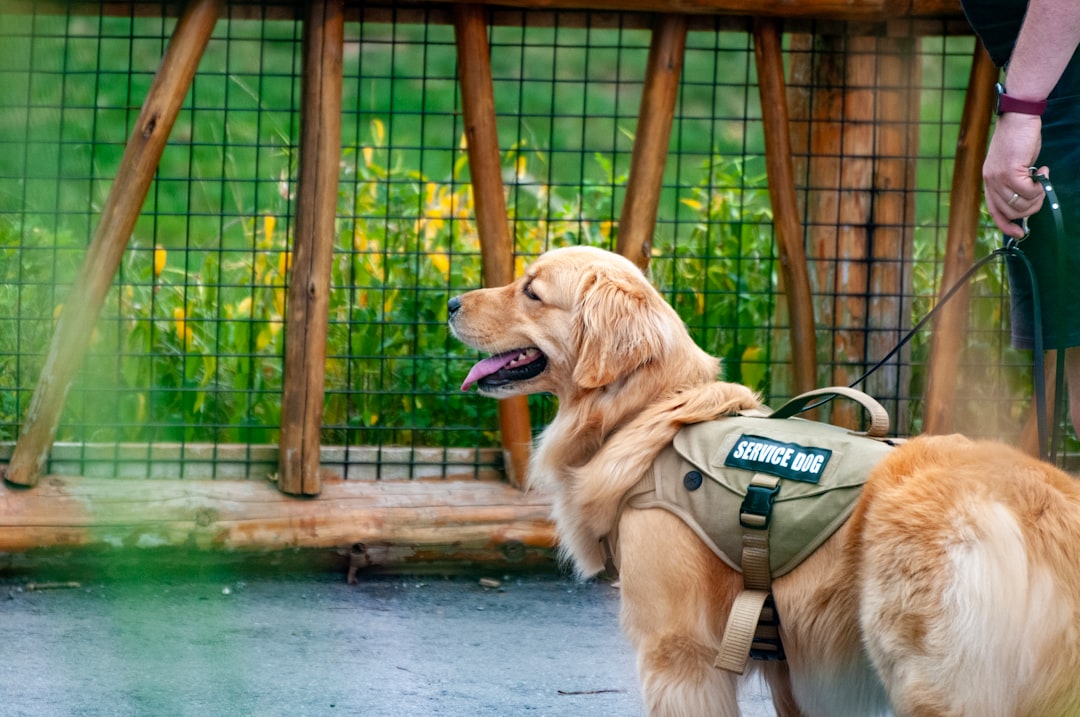
I have been training service dogs for fifteen years. I hold a Certified Service Dog Trainer (CSDT #6202) credential issued by the International Association of Canine Professionals, one of fewer than ten active credentials of that designation worldwide. In that time I have evaluated hundreds of dogs presented to handlers as "program-trained" or "fully finished" service animals. I can count on one hand the ones that were genuinely ready. The rest had a common thread: they came out of board-and-train programs that promised something the model structurally cannot deliver.
This is not an attack on every trainer who runs residential programs. Some of my colleagues do excellent foundational work inside that format. My concern is with the promise attached to those programs, particularly when the promise involves a service dog and a handler who has a disability that depends on that animal's reliability. The stakes in that equation are different from pet obedience. A Lab that blows a recall in the backyard is embarrassing. A psychiatric service dog that alerts unreliably during a dissociative episode can put someone in a hospital.
So let me walk through the structural problems honestly, the way I walk through them with every family that contacts TheraPetic® Healthcare Provider Group asking whether a board-and-train is a viable path to a service dog.
The Appeal of Sending a Dog Away
I understand why board-and-train programs are attractive. A person with a disability is often already managing significant cognitive load, fatigue, mobility limitation or emotional dysregulation. The idea that a dog can be dropped off and returned as a working partner is genuinely appealing. Life does not pause while you train. And the marketing language these programs use is deliberately designed to meet people at that exhaustion point.
"We do the hard work so you don't have to." "Professionally trained and handler-ready." "Fully task-trained for your specific disability." I see this copy constantly. It sounds like a solution. The problem is that none of those phrases describe how learning actually works in a dog, and none of them account for the human half of the working team.
Board-and-train has a legitimate place in companion dog training. For teaching basic manners or foundational obedience to a family that lacks the time or skill to train consistently, a residential program with strong transfer sessions can move the needle. But service dog work is categorically different. The difference is not about the complexity of the tasks. It is about where the behavior has to perform.
The Transfer Problem Nobody Talks About
Stimulus control is the technical concept at the center of this failure. A behavior is under stimulus control when it occurs reliably in the presence of a specific cue and not in its absence. When a trainer teaches a dog a task over six weeks of daily repetitions, the dog's behavior becomes finely tuned to that trainer's cue delivery, body language, timing, scent, emotional state and physical presence. The dog is not learning an abstract skill. The dog is learning to read that specific human.
When the dog goes home to a handler who moves differently, smells differently, cues with different timing and has entirely different nervous system patterns, that behavioral history does not transfer automatically. This is what learning science calls a stimulus generalization failure. The dog was never actually trained to respond to the handler. The dog was trained to respond to the trainer, inside the trainer's facility, in the trainer's daily routine.
I have seen this play out in ways that break my heart. A veteran with PTSD pays fifteen thousand dollars for a "fully trained" PTSD service dog. The dog performed every task flawlessly for the trainer during the final evaluation. The veteran takes the dog home, has a nightmare at 2 a.m., and the dog sleeps through it. Not because the dog is defective. Because the dog was never trained to read that person's physiological signals in that person's environment. The training history lived entirely in someone else's nervous system.
The Myth of the Finished Service Dog
There is no such thing as a finished service dog. I say this to every handler I work with and I say it plainly because the industry's use of that word causes measurable harm.
Under the Americans with Disabilities Act and the Fair Housing Act, a service animal's legitimacy is grounded in the dog's current behavior, not in its training history. A dog that was impeccably trained two years ago but has been living without maintenance work is not a compliant service animal. The law does not care about the certificate on the wall. Public access behavior is a living thing. It degrades without maintenance. It requires ongoing reinforcement from the handler the dog actually lives with.
Programs that sell a "finished" dog are selling a photograph of a moment in time. What they cannot sell is the relationship between that dog and the specific human who will be giving it cues in a crowded grocery store after a stressful workday. That relationship is not trainable in the trainer's absence. It has to be built between the dog and the actual handler, with real repetition, real feedback and real consequence.
The American Kennel Club's Canine Good Citizen program, which I use as a behavioral baseline for public access readiness, requires the dog to perform with its handler present and handling. The reason is not bureaucratic. The reason is that the dog-handler dyad is the unit of behavior, not the dog alone.
Why the Math Does Not Work
Let me put this in concrete terms. A legitimate service dog requires somewhere between 120 and 200 hours of task-specific training, plus public access conditioning, plus socialization maintenance, plus handler-directed training time. Program-based organizations that operate ethically spread that work across eighteen to twenty-four months, deliberately including the handler in training from early stages.
A typical board-and-train program runs four to eight weeks. At six hours of active training per day, that is 168 to 336 hours of trainer-directed work. On paper the hour count looks acceptable. The variable that collapses the math is that zero of those hours belong to the handler. None of the learning history is anchored in the handler's cues, environment or timing. Every hour has to be partially rebuilt after transfer.
Add to that the environmental factor. Dogs trained exclusively in a facility environment, even one with public access field trips, have not been conditioned to the handler's home, the handler's neighborhood, the handler's vehicle, the handler's medical equipment or the sensory signature of the handler's specific disability presentation. Generalization to novel environments requires systematic exposure, not assumed transfer.
The programs that charge the most and promise the most are often the ones that understand their customers' desperation. I do not use that word lightly. Families who need a service dog are often at a point of genuine medical need. Predatory pricing on top of a structurally flawed model is an ethics problem the industry has not adequately confronted.
What Realistic Programs Actually Look Like
The service dog programs I respect share a design principle: the handler is a participant in training from the beginning, not a recipient at the end. At officialservicedog.com Training Plus, the framework we use builds handler competency in parallel with dog competency because they are not separable outcomes.
Realistic programs include mandatory handler education on learning theory, cue mechanics, reinforcement schedules and behavioral maintenance. They include supervised public access training with the handler present and handling. They include explicit transfer protocols where the trainer systematically fades their own presence while the handler takes over cue delivery. And they include follow-up support after the dog goes home, because the transition period is where the fragility of the training shows up.
Residential components have a place in this model, but they are foundational, not final. Using a board-and-train period to build a strong behavioral foundation, particularly for a dog that needs intensive socialization or task foundation work, is legitimate. Calling that completed residential period a finished service dog is not.
The Assistance Dogs International standards, which are the closest thing the industry has to a recognized accreditation framework, require that handlers receive a minimum of one hundred hours of team training before graduation. That is handler hours, not facility hours. Programs operating inside that framework do not produce "finished" dogs in four weeks because the standard does not allow it.
Red Flags to Watch Before You Sign Anything
If you are evaluating a service dog program, these are the patterns that should stop the conversation:
- The program describes the dog as "finished" or "ready" without describing what handler training is included after pickup.
- Handler involvement during training is optional rather than required.
- The program cannot articulate a specific transfer protocol and what that process looks like week by week.
- Public access guarantees are offered without a behavioral maintenance plan attached.
- The trainer cannot explain stimulus control, generalization or handler-directed reinforcement in plain language.
- No follow-up support structure exists after the dog is placed.
- The program timeline is shorter than six months for a dog being presented as a trained service animal.
I would also ask any program to explain how they evaluate handler competency. If the answer is vague or handler competency is not evaluated at all, that tells you the program is dog-focused rather than team-focused. A team that cannot function without the trainer present is not a trained team.
The Handler Is Never Optional
Fifteen years of direct work in this field have given me a clear view of where service dog placements succeed and where they collapse. The single most predictive variable is not dog quality. It is handler investment during training. Handlers who train alongside their dog from early stages build a working relationship that is genuinely their own. They know how to read their dog. They know how to maintain behaviors. They know when something is off and how to address it before a small behavioral drift becomes a public access failure.
Handlers who receive a "finished" dog and are handed a training manual have none of that. They have a dog who is tuned to someone else and a relationship that has not yet been built. Some of those teams figure it out over months of hard work. Many do not, and the dog ends up returned to the program or living as a pet while the handler goes back to managing their disability without support.
The service dog industry needs to be honest about this. Not because board-and-train as a format is evil, but because the way it is marketed to people with disabilities frequently overpromises in a context where the consequences of failure are medical. My role as a CSDT is to be accurate about what training can and cannot deliver, even when accuracy is not what people want to hear when they are desperate for a solution.
If you are in the process of evaluating programs, I am glad to walk through evaluation criteria. You can reach the team at TheraPetic® Healthcare Provider Group or review the public access training standards we use at officialservicedog.com Training Plus. The right program exists. Finding it requires asking uncomfortable questions and being willing to hear honest answers.