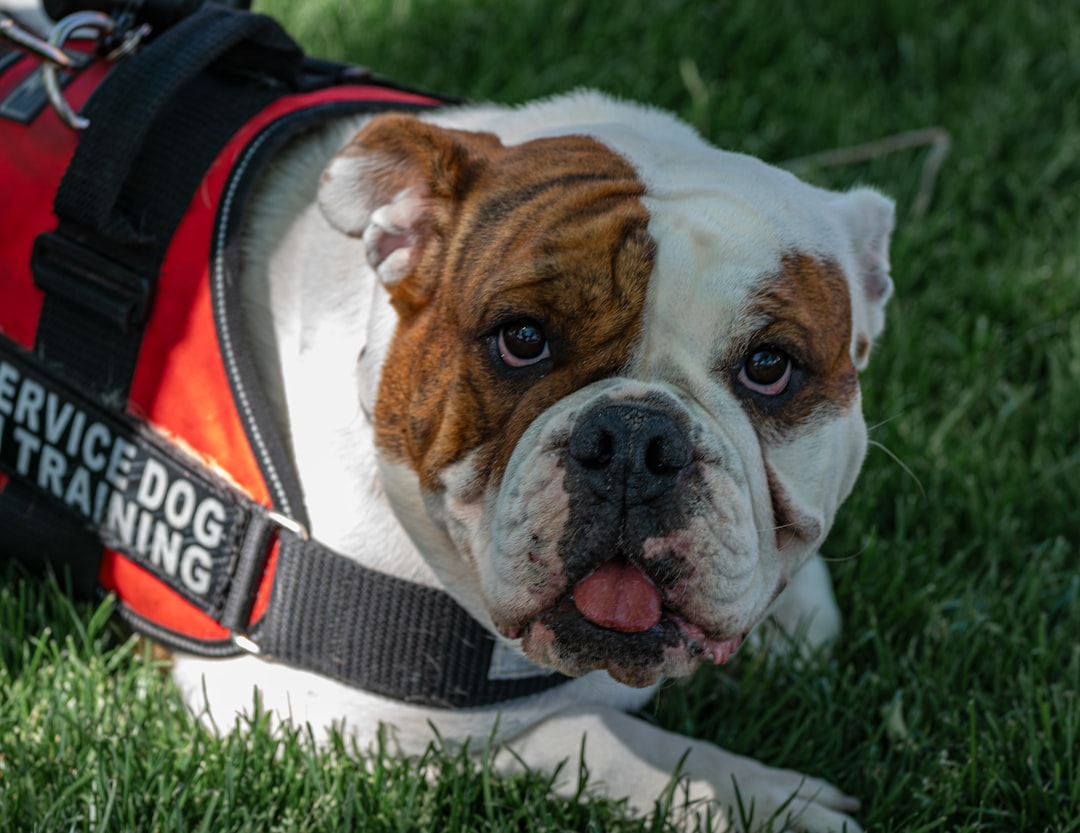
Two Ends of the Leash
I have watched hundreds of handler-dog teams work in clinical settings, public access environments and formal task evaluation. The single most consistent thing I notice is this: novice handlers watch their dogs. Experienced handlers watch themselves watching their dogs.
That distinction sounds philosophical. It is entirely practical.
Handler-dog communication is a two-way system, and most of the breakdown I observe in struggling teams originates at the human end. The dog is doing exactly what the environment and the handler are telling it to do. The handler, reading only the surface output, concludes the dog is "not reliable" or "distracted" when the actual signal is a perfect mirror of what the handler is broadcasting.
After fifteen years of working in service animal documentation, team training and behavioral assessment through TheraPetic® Healthcare Provider Group, I want to walk through what the canine communication literature calls "pre-signal behavior" and what I have started calling the handler communication blind spot. Both matter. Neither gets enough attention in standard handler education curricula.
The Microexpressions Novice Handlers Miss
Every dog trainer who has completed foundational ethology coursework knows the classic stress signals: lip licking, yawning, whale eye, piloerection along the hackles. Those are macroexpressions. They are late-stage signals. By the time you see whale eye, the dog has already been communicating discomfort for minutes.
The signals that matter most in a working team are the ones that precede those obvious markers by thirty to ninety seconds. I call these microexpressions because they are brief, low-amplitude and easy to rationalize away.
Watch for a nostril flare that happens without any obvious olfactory target in the environment. Watch for a single blink that is slightly slower than the dog's baseline blink rate. Watch for the dog's ear canal rotating forward by just a few degrees when the handler's breathing rate changes. Watch for the subtle shift of weight onto the rear haunches that happens before a dog who is about to disengage from a task fully commits to that disengagement.
None of these signals look like "something is wrong" to a handler who has been working with dogs for less than three or four years. They look like nothing. That is exactly why they are so important. The dog is communicating. The handler is not receiving. The gap between those two realities widens with every repetition until the team has a pattern that is very hard to untangle.
When I assess teams through the Training Plus program, I record video of the working session and then review it at half speed with the handler. Most handlers are genuinely shocked to see how many pre-signal moments they walked directly through without acknowledgment. That shock is productive. It is the beginning of real observational fluency.
Redirection Signals and What They Are Actually Telling You
Redirection signals are a specific subcategory of canine communication that occupies a strange middle space. They are not calming signals in the classic Turid Rugaas sense. They are not full stress responses. They are the dog's behavioral attempt to renegotiate the current situation without escalating conflict.
A working dog who suddenly sniffs the ground mid-task is not "blowing off" the handler. The dog is offering a behavioral buffer. It is saying, in the clearest language available to it, that the current demand level or environmental pressure exceeds its current capacity to comply without internal cost.
I have observed three redirection patterns that appear repeatedly across species-consistent working dog breeds.
The first is environmental scanning. The dog's gaze sweeps the room in a deliberate arc while the handler is issuing a cue. The dog is not distracted by something specific. It is performing a displacement behavior that reduces the social pressure of direct handler eye contact and cue delivery.
The second is grooming insertion. The dog pauses between task components to lick a paw or scratch briefly behind an ear. This is particularly common in teams where the task chain is longer than the dog's current reinforcement schedule supports. The grooming is self-soothing. It is also a request for the handler to restructure the reinforcement architecture.
The third is proximity adjustment. The dog maintains technical compliance with a position cue but shifts weight incrementally away from the handler over the course of several minutes. If you map the dog's body position at the beginning and end of a ten-minute working session, a poorly calibrated team will often show a six to twelve inch drift that neither the handler nor the dog is consciously aware of.
Reading these patterns correctly requires a handler to resist the instinct to correct and instead ask what the dog is responding to. That is a cognitive reorientation most novice handlers are not trained to make.
Handler Habits That Quietly Undermine Trained Work
This is the section that produces the most discomfort in handler education sessions. People accept that their dogs have communication gaps. They are far less comfortable accepting that their own habitual behaviors are systematically degrading trained work.
The first pattern I see is leash tension as emotional broadcast. A handler who is anxious in a crowded environment will almost always shorten their grip on the leash and increase baseline tension by thirty to fifty percent without realizing it. The dog reads that tension as a threat signal. It begins scanning for the threat the handler is apparently already aware of. Task focus collapses. The handler interprets this as the dog being reactive to the environment. The actual antecedent is the handler's own nervous system broadcasting through six feet of nylon webbing.
The second pattern is inconsistent marking. Handlers who have been taught to use a verbal marker or clicker frequently drift into imprecise timing as their comfort with a dog increases. The mark starts arriving a half second late. Then a full second late. From the dog's associative learning perspective, you have now changed what behavior you are marking without updating the cue. The dog begins offering variations, looking for the response that produces the marker. The handler reads this as the dog "forgetting" the trained behavior. The dog is problem-solving correctly for the feedback it is actually receiving.
The third pattern is gaze pressure. Many handlers, particularly those who are newer to public access work, maintain prolonged direct eye contact with their dog as a monitoring strategy. To the dog, sustained eye contact from a handler who is not in an active training moment reads as social pressure. It elevates the dog's arousal state, suppresses autonomous task initiation and over time creates a dog that is waiting for handler direction rather than working as an independent alert or response animal.
I hold a Certified Service Dog Trainer credential through the International Association of Canine Professionals. It is one of fewer than ten active CSDT credentials worldwide. The standard that credential requires is precisely this level of bilateral analysis: you cannot assess team performance without assessing both team members with equal rigor.
Reading Stress Accumulation Before It Becomes a Problem
Stress accumulation in working dogs is not linear and it is not always visible in real time. The behavioral science literature on cortisol recovery in dogs is consistent: significant stressors can produce measurable behavioral changes for up to seventy-two hours after the inciting event. That means a dog who had a difficult public access outing on Thursday may be operating from a compromised neurological baseline on Saturday's training session.
Experienced handlers track what I call a stress ledger. They note the quality of each working day, the environmental stressors encountered, the physical demands placed on the dog and the approximate recovery time they are allowing. They do not evaluate their dog's performance in isolation. They evaluate it in context of the cumulative load over the preceding several days.
Novice handlers evaluate each session as if it exists in a vacuum. The dog who was perfect on Monday and inconsistent on Wednesday is not being unpredictable. It is expressing a stress debt that accumulated between those two dates and that the handler did not record because the handler was not watching at that level of resolution.
Building a simple session log with behavioral quality ratings, environmental stressor notes and reinforcement density records changes this entirely. It transforms team performance evaluation from impression-based to data-based. That shift alone produces measurable improvements in training efficiency because the handler stops solving the wrong problem.
Building Observational Fluency as a Trained Skill
Observation is not a personality trait. It is a skill with discrete components that can be trained systematically.
The first component is baseline calibration. Before you can identify deviation, you need a precise knowledge of what your dog's neutral behavioral state looks like. I mean this in granular terms: baseline ear position, baseline blink rate, baseline respiratory rate during rest and during active work, baseline muscle tone across the shoulder and jaw. You cannot identify a two-degree ear shift as meaningful if you have never formally mapped where the ears sit at baseline.
The second component is split-attention training. Practice maintaining awareness of your own body simultaneously with your dog's behavior. Audio recording your verbal interactions during training sessions and reviewing them later is a useful exercise. Most handlers are surprised by the frequency with which their tone, volume and pacing shift in ways they did not intend and the dog responded to.
The third component is video-based behavioral analysis. Record working sessions regularly. Review them at reduced speed with a specific observational focus each session: one session focused only on ear movement, one focused only on weight distribution, one focused only on handler leash tension. Narrow focus produces detailed observation. Broad focus produces general impression.
The Certification Council for Professional Dog Trainers includes applied ethology and behavioral observation in its competency framework for good reason. Observational fluency is the infrastructure under every other training skill. Without it, technical proficiency in cue delivery and reinforcement mechanics cannot reach its potential.
What Fifteen Years of Watching Teams Has Actually Taught Me
The most common thing I hear from handlers after a detailed team assessment is some version of: "I had no idea how much I was saying." They mean that they had not understood themselves as an active communicator in the working relationship. They thought they were the observer. They discover they are simultaneously the observer and a primary variable in the system they are trying to observe.
That realization changes how a handler carries themselves. It changes how they enter a room, how they breathe through a difficult public access moment, how they structure the timing between task cues. It produces teams that look qualitatively different from the outside: smoother, quieter, more effortless. What looks effortless is actually precision. It is two organisms who have built a shared observational language fine enough to communicate in increments most people cannot see.
Service dog work at its best is not obedience. It is not compliance. It is a working partnership between two nervous systems that have learned to read each other below the threshold of conscious articulation. That kind of communication does not happen by accident and it does not happen quickly.
It happens because someone decided to watch both ends of the leash with equal care, session after session, year after year, until the watching became second nature and the whole team got quieter and more effective as a result.
That is the work. That is what the credential requires. That is what the dog deserves.